

Last week I had the opportunity to attend the 25th annual Net Impact conference in Atlanta, GA. For those unfamiliar with Net Impact, it is an organization that was started by MBA students with the goal of bringing impact and purpose mainstream. Currently there are over 300 chapters across the country with tens of thousands of members.
This year’s theme was Path to Purpose which aimed to help attendees explore what it means to them to build a career with purpose. The event began with several boot ca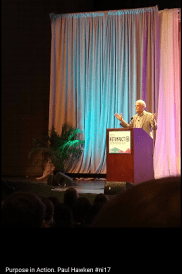 mp sessions around design thinking, racial equity, and advancing in an impact career. There was also a symposium on leading with the triple bottom line. Following was the 2017 cohort Fellowship kickoff, which I took part in as a Tech for Good fellow.
Of the two keynotes given during the conference, my favorite was actually on climate change. The speakers were Paul Hawken, Executive Director of Project Drawdown, and Derreck Kayongo, CEO of the National Center for Civil and Human Rights. Derreck gave an inspiring, and at times funny, speech about his childhood in Uganda, to coming to the U.S. and seeing how much hotels waste soap. He noted that the over 800 million bars of soap are thrown out by hotels annually, leading to compromised decomposition of waste that actually affects climate change.
My experience at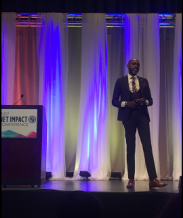 the conference was very informative and inspiring. Given that I am part of the Tech for Good fellowship, the sessions I attended were obviously geared toward technology. For me, the most interesting sessions were Leveraging Tech as a Force for Good and How Tech is Changing Philanthropy. Side note, I am pretty disappointed in missing the Founders Who Paved their Own Way session on startups and corporate impact since that is something I am working on.
One of the requirements for the fellowship is to create an impact project locally and document the process and the outcomes. I will be using this blog to track some of the progress on my impact project, as well as my progress of starting a Net Impact chapter on Point Park’s campus. I have a really good idea for the impact proposal that will benefit Pittsburgh non-profit organizations, so keep a lookout for future posts.
 re using the App Store or the Google Play store, you can’t help but notice the large number of replicated applications from astrology apps to credit score tracking apps. There are literally thousands of budgeting apps and there over one hundred different period trackers.
 our phone, to what we read on our phone before we go to bed, and everything in between. Using our phones to make simple, yet meaningful contributions to the world we live, on a local or global level, is a great opportunity that more people should engage in and support.
 s. This leads one to believe that the job market has turned into a seller’s market over the years, where quality job seekers come a dime a dozen and employers have their pick. While this may be the case for the average job seekers simply looking to get their foot in the door. This is not the case for top talent with their own set of requirements they expect from an employer.
 BMCo.
BMCo. 