Why Corporate Social Responsibility Remains Vital in 2025

Corporate Social Responsibility (CSR) has historically played a significant role in bridging the gap between corporations and the communities they impact. Fast-forward to 2025, and CSR is no longer a supplementary business initiative—it’s a business imperative. For business leaders and CSR professionals, the coming years present both challenges and opportunities to elevate their responsibility toward people, planet, and profit. Here’s why CSR remains critical, and how companies can embed purposeful efforts into their operations.

The Rising Importance of CSR in Business Success

Modern consumers are increasingly holding companies accountable for their impact on society and the environment. A study conducted by Cone Communications revealed that 87% of consumers opt for businesses that actively support social or environmental issues. This shift in consumer behavior demonstrates that CSR is no longer optional—it’s expected.

Beyond consumer loyalty, investors, stakeholders, and governments are also raising the bar. Regulatory frameworks around emission reductions, fair labor practices, and sustainability are becoming tighter. Companies leading with a CSR ethos build resilience against reputational risks and create long-term shareholder value.

The Consumer’s Voice is Growing Louder

Consumers in 2025 are looking beyond products and services—they’re scrutinizing the practices that made them possible. Younger generations such as Gen Z and Millennials, who now represent the majority of the global workforce and consumer base, inherently value social and environmental responsibility.

Transparency matters. Whether it’s fair trade sourcing, ethical manufacturing, or contributions to community programs, businesses that are upfront about their initiatives and successes build trust. On the other hand, companies that fail or attempt to use CSR as lip service risk public backlash, which can severely damage their reputation.

CSR Fuels Brand Reputation and Talent Acquisition

A strong CSR strategy doesn’t just win over consumers—it attracts the best talent. A LinkedIn survey found that nearly 70% of employees prefer to work for companies with a strong social purpose. Highly skilled professionals want to be associated with a brand that aligns with their values.

For example, businesses that actively work to reduce their carbon footprint or enhance diversity, equity, and inclusion (DEI) initiatives create workplaces that are not only competitive but also exemplary. CSR drives employee satisfaction, engagement, and retention—a win-win for the workforce and organizational success.

Environmental Sustainability as a CSR Priority

Environmental sustainability continues to lead the CSR agenda. The climate crisis demands urgent action, and corporations hold tremendous power to enact large-scale change. Commitments to renewable energy, waste reduction, and carbon neutrality are no longer “nice to have” but essential components of business strategy.

Take global giants like Patagonia and IKEA, who have seamlessly integrated environmental sustainability into their brand ethos. Their programs not only reduce ecological impact but also position them as leaders in sustainability-driven innovation.

For businesses still navigating this transition, adopting environmentally sustainable practices can start small—improving supply chain transparency, introducing zero-waste packaging, or minimizing energy usage in operations. These incremental changes can compound to create greater impact over time.

Transparency, Accountability, and Stakeholder Engagement Are Non-negotiable

A successful CSR strategy hinges on transparency, accountability, and stakeholder engagement. Without these principles, CSR efforts risk being perceived as insincere or performative.

  • Transparency ensures stakeholders—including consumers, investors, and employees—have an accurate understanding of what the company is doing. This might include publishing CSR reports, setting measurable goals, and openly sharing progress.
  • Accountability builds trust. Companies must take responsibility for both achievements and setbacks in their CSR efforts. Openly addressing challenges demonstrates authenticity and commitment.
  • Stakeholder Engagement helps businesses align strategies with the needs of their communities. Engaging employees, customers, and local organizations in the planning and implementation of CSR initiatives empowers all parties and drives results.

2025 and Beyond: Looking Ahead

CSR in 2025 is more than a trend; it’s a compass guiding businesses toward sustainability, equity, and profitability. For organizations that aspire to make a difference while remaining competitive, the integration of meaningful and measurable social responsibility is essential.

Business leaders have the opportunity to not only answer the evolving demands of consumers, employees, and stakeholders but also inspire others to follow suit. With tools like transparency, accountability, and engagement, businesses can drive social change while building a legacy of lasting impact.

At BMC0., we’re here to help you align your business goals with the core principles of corporate social responsibility. Together, we can build strategies that empower your organization to be a force for good. It’s not just about staying relevant—it’s about leading the way.


The 4 Day Work Week Revisited: Is it the Key to Employee Engagement?

In recent years, more and more companies are exploring the idea of a 4 day work week as a means of increasing employee engagement and reducing burnout. The concept has been around for a while, but it’s gained renewed popularity lately due to the pandemic and the shift to remote work. The idea may sound appealing to employees who are craving more work-life balance, but it may not be the best solution for every company. In this blog post, we will explore the pros and cons of a 4 day work week and whether it can really improve employee engagement.

Pros:

Improved Work-Life Balance: A 4 day work week allows employees to have more time for themselves, their hobbies, and their families. This can result in lower stress levels, better mental health, and increased job satisfaction. Employees who have a good work-life balance are more likely to be engaged and productive at work.

Increased Happiness: Studies have shown that employees who work fewer hours are happier and more satisfied with their jobs. When employees enjoy their work, they tend to be more engaged and motivated, which can lead to better performance and increased productivity.

More Time for Personal Development: With an extra day off, employees can use that time to focus on improving their skills, pursuing a hobby, or even volunteering. Providing opportunities for personal growth can help employees feel fulfilled and invested in their work.

Increased Productivity: When employees are expected to accomplish their tasks in less time, they may become more efficient and productive. There would be less time wasted being idle and more focus on completing tasks.

Cons:

Reduced Productivity: While a 4 day work week may be appealing, it can also lead to reduced productivity if not managed well. Employees may struggle to maintain focus and motivation without regular breaks, and workloads may need to be adjusted accordingly.

Difficulty in Scheduling: For companies that require employees to work on specific days or shifts, implementing a 4 day work week can be challenging. It may require extra planning and coordination to ensure that all necessary tasks are completed, and clients or customers are not left waiting.

Increased Costs: A 4 day work week may require additional staffing or overtime to cover days when employees are off. This can result in increased labor costs, which may not be feasible for every company.

In conclusion, a 4 day work week can be an effective way to improve employee engagement and work-life balance, but it may not be suitable for every company. Before making any changes to the work schedule, it’s essential to weigh the pros and cons and consider the unique needs of your employees and business. Finding the right balance between work and life is crucial, but it’s also important to ensure that business goals are met, and customers are satisfied. Ultimately, the best approach is to keep an open mind and be willing to experiment with different strategies to find what works best for your team.

The Benefits of Employee Engagement Through Social Exchange Theory

Employee engagement is a key factor in keeping employees motivated and productive. One model that has been used to explain employee engagement is social exchange theory, which focuses on the dynamics of an employee-employer relationship. This theory is based on the idea that employees are motivated by the rewards they receive in return for their work, and this motivation is what drives engagement. Let’s explore how social exchange theory can be used to foster employee engagement.


Understanding Social Exchange Theory
Social exchange theory states that individuals engage in relationships where they expect to receive something in return for their contributions. This could be tangible rewards such as money or promotions, or intangible rewards such as recognition or respect. The amount of effort and commitment an individual will put into a relationship depends on how satisfied they are with what they are receiving from it. If an individual feels like they are not being adequately rewarded, then the likelihood of their continued involvement decreases significantly.

How to Implement Social Exchange Theory
The key to using social exchange theory to increase employee engagement is understanding what motivates your team members and providing them with adequate rewards for their hard work and dedication. A great way to do this is through recognition programs that reward employees for meeting goals or going above and beyond in their duties. You can also create opportunities for employees to connect with each other and build relationships, which helps foster a sense of community within your organization. By showing appreciation for your team’s efforts, you can create an environment where everyone feels valued and appreciated, resulting in greater loyalty, productivity, and engagement overall.

The Role of Leaders
Leaders play an important role in implementing social exchange theory within organizations. They need to be able to recognize when employees feel undervalued or unappreciated so that they can take steps to address those issues accordingly. Leaders should also be willing to listen to feedback from their teams so that they can make necessary changes if needed. Additionally, leaders should strive to provide clear expectations so that employees know exactly what is expected of them and how they will be rewarded for meeting those expectations. By creating a supportive environment where everyone’s needs are taken into consideration, leaders can ensure more effective implementation of social exchange theory within their organization.


Social exchange theory provides us with valuable insights into how we can foster better employee engagement within our organizations by understanding what motivates our team members and rewarding them appropriately for the work they do. Leaders have the power to create a supportive work environment where everyone feels respected and appreciated by taking steps such as implementing recognition programs, building relationships among staff members, listening to feedback from their teams, and providing clear expectations for performance outcomes. When these steps are taken correctly, organizations can see significant improvements in morale as well as increased productivity among staff members over time—all thanks to social exchange theory!

How Corporate Social Responsibility Can Help Your SMB Grow

In the age of corporate transparency, businesses of all sizes are recognizing the potential of corporate social responsibility (CSR) to help them grow. Many small and medium-sized businesses (SMBs) are now looking to CSR initiatives as a way to boost their bottom line, while also contributing to society in meaningful ways. Let’s take a look at how CSR can help your SMB become more successful.


How CSR Helps Your Business Grow
One of the main benefits of CSR is that it can build trust with consumers. When customers see that your company is taking steps to improve its environmental and social impact, they will be more likely to view your business favorably. This can lead to increased customer loyalty, which can result in increased sales and repeat business. Additionally, having a strong CSR program in place can make your business stand out from competitors who are not taking similar steps in their operations or initiatives.

The implementation of a CSR strategy has been shown to have positive effects on employee morale as well. When employees know that their employer takes an active interest in making the world a better place, they feel more connected and invested in the success of the company. This sense of belonging and pride can lead to improved job satisfaction, which often leads to greater productivity and creativity on the job.

Finally, many companies are now turning to CSR initiatives as part of their marketing efforts. By engaging in activities such as volunteering or donating money or goods to causes related to their industry or mission statement, companies can increase brand awareness while also demonstrating their commitment to helping others. A strong online presence is essential for any business today, but having a reputation for being socially responsible will add another layer of credibility and visibility for your business both online and off.

It’s clear that engaging in corporate social responsibility has many benefits for SMBs looking for ways to increase their revenue streams while also making an impact on society at large. From building trust with customers and improving employee morale, to increasing brand awareness through marketing efforts—CSR initiatives provide tangible benefits that any size business should consider taking advantage of when planning for future growth.

Repeal Pittsburgh’s Historic Preservation Law

Pittsburgh, Pennsylvania, is the poster child for why many people hate historic preservation. Enacted in 1971 and amended several times, the law created a clunky, confusing, and biased process for designating and regulating historic landmarks and districts. Over its 51-year history, at least two Historic Review Commission chairpersons have resigned because of procedural irregularities.

Repeal Pittsburgh’s Historic Preservation Law

8 Ways Diverse Companies are Winning

Learn why companies with diverse leadership are performing better than their less diverse counterparts.

Diversity, equity, and inclusion in the workplace have become increasingly important as societal issues, including racial and cultural bias and racism, have been thrust into the forefront of the media. Insert a global pandemic into the mix, and diversity, equity, and inclusion matter now more than ever.  The spotlight has been placed on leadership teams around the world proving to be one of the greatest tests of their ability, efficiency, and transparency.  Not only must leaders act in the manner that best accommodates their employees and customers in a health crisis, they must strategize how to circumvent operational disruption.  With a shifting in priorities, it is crucial that diversity, equity, and inclusion do not take a back seat as these components are actually factors in how leaders respond to these unprecedented circumstances.

Diversity, Equity, & Inclusion

While each of the terms have their own respective definitions, together they represent a concept focused on fairness in the workplace, in education, and in the market.

The term Diversity encompasses the ways in which people or groups differ from one another, the differences that make them unique. Diversity is not limited to race, culture, and ethnicity. It also includes the items you may be used to seeing when asked to complete demographic information. These demographic items include age, gender, national origin, sexual orientation, disability, socioeconomic status, religion, marital status, and often times, education level.  Diversity can also describe differing worldview, thoughts, ideas, perspectives, and values. 

Equity refers to the fairness in treatment, access, opportunity, and advancement for everyone despite all of the differences that make the population diverse.  In addition, equity involves the identification and elimination of existing barriers that have prevented access or opportunity to certain groups of people.  In order to improve equity, institutional systems must become just and fair with respect to processes and procedures, as well as in the accessibility of resources. Addressing equity means addressing root and systemic causes for disparities within our society.

Lastly, the term inclusion refers to the act of creating environments where all individuals and groups are welcomed, respected, supported, and valued. Inclusive spaces encourage full participation of all. An inclusive and welcoming environment embraces the differences of individuals and groups while showing respect in, not only words, but most importantly actions.

Simply promoting diversity does not yield a culture of inclusion. It’s important to note that while an inclusive group is by definition diverse, a diverse group isn’t always inclusive. Increasingly, recognition of unconscious or ‘implicit bias’ helps organizations to be deliberate about addressing issues of inclusivity.

Investment in diversity, equity, and inclusion can be significant when done the right way. However, the return on investment will be well worth it as organizations benefit in a multitude of ways, from a more engaged workforce to a positively impacted bottom-line. The following list shows 8 evidence based ways that diverse companies are winning in the market place.

  1. 36% More Likely to be Profitable

Companies with diverse leadership teams respective of experience, age, industry background, and gender have proven to show increased profitability. However, cultural and ethnical diversity in leadership teams has been proven to hav the most significant impact on profitability. These companies are 36 percent more likely to be profitable than their less diverse counterparts.  This can be due to innovation as there are differing viewpoints, backgrounds, and ideas at the table.

2. 28% More profitable with gender diverse leadership. 

Higher representation of women in C-suite level positions results in 34 precent greater returns to shareholders. Increasing the percentage of women on a leadership team strengthens skills diversity amongst the organization to improve management performance. Women in upper management positions may also motivate women throughout an organization’s workforce, creating a pipeline of talented women leaders.

3. Innovation through diverse ideas

Companies that have diverse leadership are able to unlock innovation for market growth in a way that less diverse leadership can’t. A diverse leadership team encourages an environment where forward thought, and “out of the box” ideas can be brought to the table to create compelling and innovative initiatives. Leaders who bring diverse voices to the table are nearly twice as likely as their counterparts to yield value-driving insights.

4. Outperform less gender diverse companies by 58%

Gender diverse organizations help attract and retain quality talent. Organizations with above-average gender diversity and levels of employee engagement outperform companies with below-average diversity and engagement by 46 to 58 percent.

5. Engaged employees

Diversity, equity, and inclusion are closely linked to employee engagement. Studies have provided evidence that diversity, equity, and inclusion are critical components in employee retention, productivity, and performance.  When employees feel included and valued, they are more likely become more engaged in the work they do and better perform while championing the organization. This, in turn, leads to better business outcomes for the organization.

6. Attracting top talent

Millennial and Generation Z are most diverse generational cohorts entering the workforce. Sixty-seven percent of job seekers value diversity, equity, and inclusion when seeking employment.  Prospective candidates are seeking companies that foster diverse and inclusive workplaces, and are more likely to stay when they feel appreciated. The advantages of workplace diversity that includes a more positive culture, increased profitability, and an atmosphere of inclusivity, are a snapshot of the many benefits a diverse organization, that help to attract and retain employees.

7.  50% of job seekers wish their organization would increase diversity 

As previously mentioned, Millennials make up the largest portion of the workforce. By the year 2025, Millennials will make up 75 percent of the workforce. A study has found that half of all employees feel that their organizations should do more to increase diversity and inclusion. Fifty-four percent say they will leave an organization for lack of commitment to diversity and inclusion.

8. 45% report more market share

Organizations with 2D or two-dimensional diversity are 45 percent more likely to report that they increased their market share and 70 percent of organizations with 2D  diversity are more likely to have entered into a new market within the past year.

Diversity, equity, and inclusion have not always been a top priority in organizations in the past. However,  in learning from past mistakes, the tides have been turning and a shift in focus has been placed on creating inclusive work environments for diverse teams. It has been evidenced that the organizations that have diverse leadership teams and focus on a culture of diversity, equity, and inclusion are actually winning. These organizations are leading in profitability, innovation, and employee recruitment and retention.  In order to foster an environment of inclusivity and build diverse teams, the action must be genuine and intentional with careful cultivation. The investment will lead to more fulfilled, more engaged employees who feel valued and better perform at work, increasing productivity, increasing client satisfaction, and ultimately increasing profitability. Organizations that are in the top quartile for 2D or two dimensional diversity including both gender and ethnic diversity are 12 percent more likely to outperform their less diverse counterparts, proving any investment in diversity, equity, and inclusion will be returned through better business outcomes. 

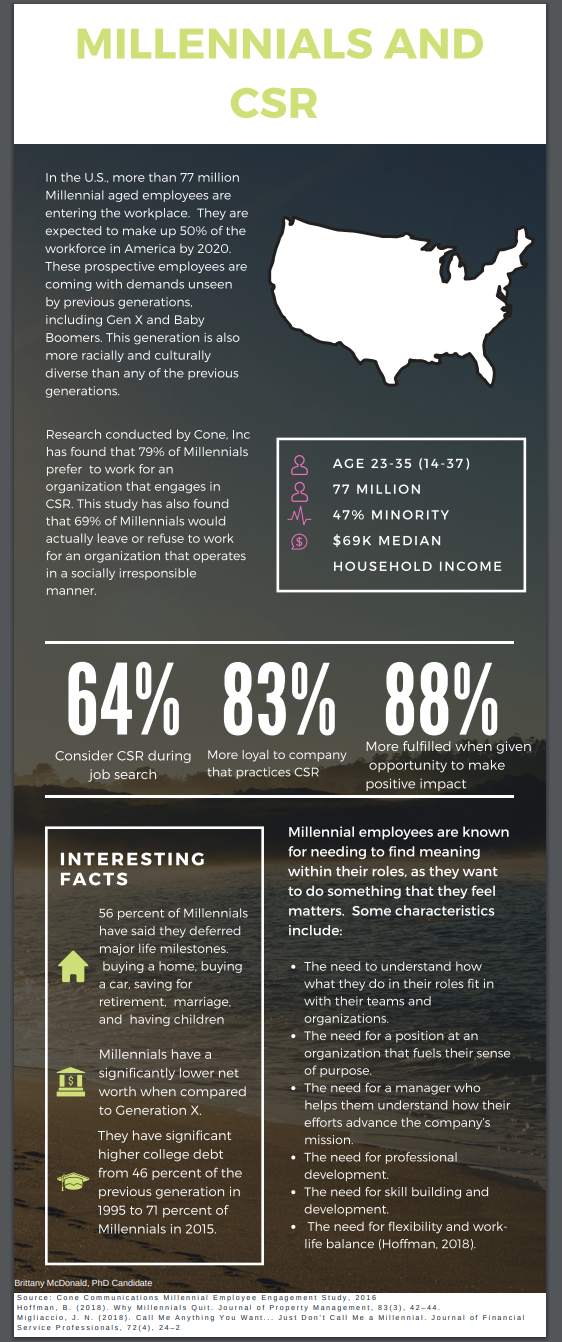
Millennials and CSR: An Infographic

This infographic was created as a supplement to my dissertation proposal defense last weekend.  It provides a high level overview of the significance of corporate social responsibility in the recruitment and engagement of millennial employees.

This infographic was created as a supplement to my dissertation proposal defense last weekend.  It provides a high level overview of the significance of corporate social responsibility in the recruitment and engagement of millennial employees.

Millennials and CSR

Screen Shot 2019-04-22 at 5.25.30 PM

#NI17 Path to Purpose

Last week I had the opportunity to attend the 25th annual Net Impact conference in Atlanta, GA.  For those unfamiliar with Net Impact, it is an organization that was started by MBA students with the goal of bringing impact and  purpose mainstream. Currently there are over 300 chapters across the country with tens of thousands of members.

This year’s theme was Path to Purpose which aimed to help attendees explore what it means to them to build a career with purpose.  The event began with several boot ca20171101_124409mp sessions around  design thinking, racial equity,  and advancing in an impact career.  There was also a symposium  on leading with the triple bottom line.  Following was the 2017 cohort Fellowship kickoff, which I took part in as a Tech for Good fellow.
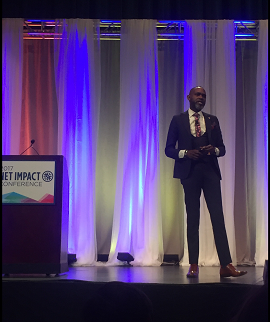
Of  the two keynotes given during the conference, my favorite was actually on climate change.  The speakers were Paul Hawken, Executive Director of Project Drawdown, and  Derreck Kayongo, CEO of the National Center for Civil and Human Rights.  Derreck gave an inspiring, and at times funny, speech about his childhood in Uganda, to coming to the U.S. and seeing how much hotels waste soap.  He noted that the over 800 million bars of soap are thrown  out by hotels annually, leading to compromised decomposition of waste that actually affects climate change.

My experience at20171101_124510 the conference was very informative and inspiring.  Given that I am part of the Tech for Good fellowship, the sessions I attended were obviously geared  toward  technology.  For me,  the most interesting sessions were Leveraging Tech as a Force for Good and How Tech is Changing Philanthropy.  Side note, I  am pretty disappointed in missing the Founders Who Paved their Own Way session on startups and corporate impact since that is something I  am working on.

One of the requirements for the fellowship is to create an impact project locally and document the process and the outcomes.  I will be using this blog to track some of the progress on my impact project, as well as my progress of starting a Net Impact chapter on Point Park’s campus. I have a really good idea for the impact proposal that will benefit Pittsburgh non-profit organizations, so keep a lookout for future posts.